
If you have been referred to the Bradford Macular Centre, it is completely normal to have questions before your first appointment. Eye clinics can feel confusing when you do not know what the scans are for, how long the visit will take, or whether you might need treatment on the same day bradford macular centre.
The Bradford Macular Centre is part of Bradford Teaching Hospitals NHS Foundation Trust and is located on Trinity Road, close to St Luke’s Hospital in Bradford. It is a specialist centre within the Trust’s ophthalmology service, with a particular focus on conditions affecting the macula and retina bradford macular centre.
I found that the most useful way to understand a clinic like this is not simply to look at a list of medical terms. What matters to a patient is much more practical: Where do I go? What happens when I arrive? Will I need an injection? Can I drive home? How long might I be there? And what should I bring?
Here is what you should know.
Where is the Bradford Macular Centre?
The Bradford Macular Centre has its own building on Trinity Road, Bradford, near St Luke’s Hospital. The Trust says the centre operates Monday to Friday, generally from 9:00am to 5:00pm.
It is worth checking your appointment letter rather than assuming every ophthalmology appointment will take place there. Bradford Teaching Hospitals uses several locations for eye services, including Bradford Royal Infirmary, the Bradford Macular Centre and the University of Bradford Eye Clinic. Some patients may also receive a “test only” appointment at a different location bradford macular centre.
That small detail can prevent an unnecessary trip across Bradford.
Contacting the centre
The Trust currently lists several telephone numbers for the Macular Unit, including:
- 01274 276503
- 01274 276507
- 01274 276504
- 01274 275223
- 01274 275222
Because telephone arrangements can change, it is sensible to use the contact details on your latest hospital letter or the current Bradford Teaching Hospitals website if you need to contact the department bradford macular centre.
What does the Bradford Macular Centre treat?
The word “macular” can make the centre sound as though it only deals with one condition. In practice, the service covers a range of retinal and macular problems bradford macular centre.
Bradford Teaching Hospitals says its ophthalmology service is involved with conditions including age-related macular degeneration (AMD), diabetic retinopathy, central serous retinopathy, central retinal vein occlusion and branch retinal vein occlusion.
An NHS job description for the service also describes the Bradford Macula Centre as providing treatment for wet age-related macular degeneration and macular oedema associated with retinal vein occlusions and diabetic retinopathy.
That does not mean every patient receives the same treatment. Your diagnosis, scan results, symptoms and previous treatment all affect what happens next bradford macular centre.
What happens at your first appointment?
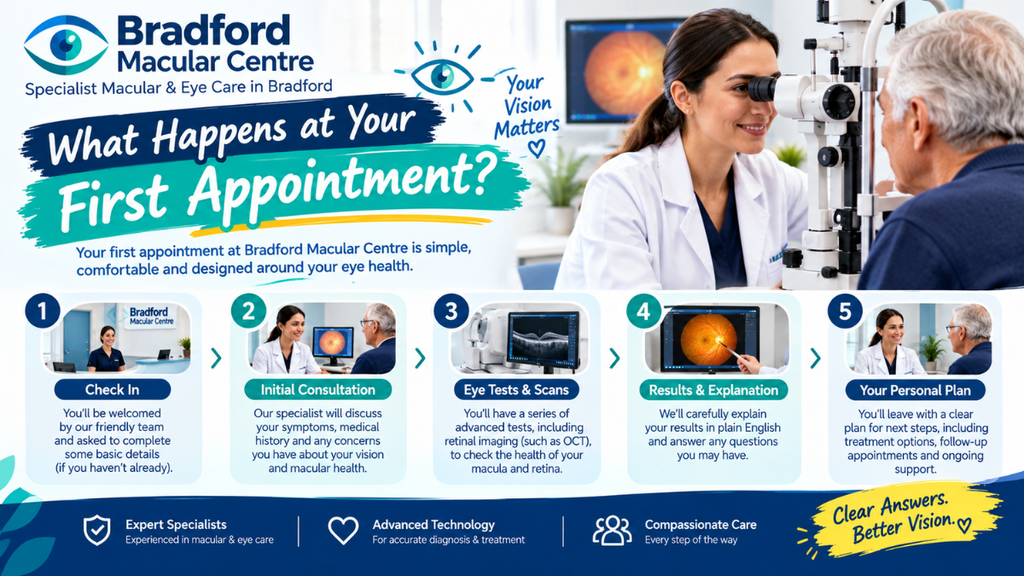
This is probably the question people want answered most.
The Trust explains that a first visit can involve several stages, so it is wise not to schedule something immediately afterwards.
1. Check in at reception
When you arrive, you will normally register at reception.
If you are unfamiliar with hospital appointments, arrive a little early rather than trying to arrive exactly at the appointment time. You may need to find parking, walk to the building and check in bradford macular centre.
Bring:
- Your appointment letter or text details
- A list of medicines
- Information about allergies
- Your glasses
- Any relevant hospital letters
- Your phone, if you use it for appointment information
If somebody normally helps you with appointments, taking them with you can also be useful.
2. Your vision is checked
The clinical team will assess your vision. The Trust says this is performed at every visit, with vision recorded using an illuminated letter chart bradford macular centre.
Do not worry if your vision seems slightly different from your last visit. The important thing is that the clinical team has a consistent measurement to compare with previous appointments bradford macular centre.
3. Your pupils are dilated
Dilating drops are normally given so the back of the eye can be examined properly.
This is one of the easiest parts of the appointment to underestimate.
Your vision may become blurred for several hours afterwards, and bright light can feel uncomfortable.
A common mistake is arranging to drive yourself home.
If you are unsure how dilation will affect you, arrange another way home, particularly if you have never had dilating drops before. Sunglasses can also make the journey more comfortable.
4. OCT scanning
You will usually have an OCT (optical coherence tomography) scan.
This is one of the most important tests used at the centre. The Trust describes OCT as a scan of the back of the eye.
The technology produces detailed images of the retina. Bradford Teaching Hospitals has previously described OCT as a key tool for identifying and monitoring conditions such as macular degeneration and diabetic eye disease.
For a patient, the process is much less intimidating than the name sounds. You generally sit at the scanning equipment, position your head as instructed and look at a target while the machine obtains the images.
There is no reason to think of an OCT scan as an invasive procedure.
5. Further tests if necessary
Not everyone needs every test.
Depending on your condition and what the clinician sees, you may be asked to have additional imaging or testing. The Trust lists fluorescein angiography as a test that may be performed if requested by the clinician. This involves dye being administered into the bloodstream so photographs can be taken at timed intervals.
The important point is that an additional test does not automatically mean something is seriously wrong. It may simply give the ophthalmology team more information before deciding how to manage your condition.
Could you receive an eye injection?
Possibly, depending on your diagnosis and the findings at your appointment.
Intravitreal injections are used in the treatment of some retinal conditions. At Bradford Macular Centre, the Trust says that when an injection is required, the team confirms the patient’s details and consent, uses anaesthetic drops and antiseptic preparation, and then performs the injection in a dedicated procedure room. The injection process itself usually takes around 10 minutes.
If you are nervous about injections, tell the clinical team.
It is better to say, “I’m quite anxious about this,” than to sit silently worrying throughout the appointment. Staff perform these procedures regularly and can explain what they are doing.
The decision to treat should also be discussed with you, including the relevant options and consent before treatment.
How long does an appointment take?
This is where people sometimes get caught out.
The Bradford Macular Centre says a first appointment could take three hours or more, because several tests may be required.
So, for example, if your appointment is at 10:00am, it would be unwise to book an important meeting for 12:00pm and assume you will definitely be finished.
A much better approach is to keep the rest of the day flexible.
The same advice applies to follow-up appointments. Some may be relatively quick, while others can involve several tests, consultation and treatment.
What should you take with you?
You do not need to pack a suitcase, but a little preparation makes a long clinic visit easier.
I would take:
Your glasses:
Even if your vision is poor, bring your normal glasses.
Medication information:
A current medication list is useful, especially if you take several medicines.
Appointment information:
Keep your letter or text message handy.
Phone charger:
It sounds trivial, but a long hospital visit can drain your phone.
Water and a small snack:
The centre says there is a drinks machine and small snacks available, but no canteen facility. The Trust specifically suggests bringing light refreshments if you are concerned about the length of the appointment.
Sunglasses:
These can be particularly useful after pupil dilation.
Can you use your phone during the appointment?
Your smartphone can actually be useful, provided you follow the clinic’s rules.
For example, you can use it to:
- Check your appointment details
- Keep a list of questions
- Set reminders for future appointments
- Record medication information
- Contact the person collecting you
A simple notes app is often enough.
Before an appointment, I would write down three questions rather than trying to remember everything once you are sitting in front of the doctor.
For example:
- What exactly is changing in my retina?
- Do I need treatment now?
- What should make me contact the hospital urgently?
That small preparation can make the consultation much more productive.
What if you have poor vision after the appointment?
The Bradford ophthalmology service has an Eye Clinic Liaison Officer (ECLO) who can provide support for people affected by sight loss. The service includes information about independence, equipment and technology, education, employment, leisure, benefits and concessions.
This is particularly useful because managing reduced vision is not only about medical treatment.
For example, someone struggling to read a phone may benefit from:
- Larger text on an iPhone or Android phone
- Screen magnification
- Voice assistants
- High-contrast settings
- Larger computer displays
- Electronic magnifiers
- Better household lighting
Bradford’s low-vision services also assess whether magnifying devices could help and can provide certain magnifiers on loan. Advice about lighting, contrast and other local resources is also available.
This is an area many patients overlook. A retinal condition may be medically stable while everyday tasks such as reading medication labels, using a bank app or recognising bus numbers remain difficult.
What if your vision suddenly gets worse?
Do not simply wait for your next routine macular appointment if you develop a sudden or significant new eye problem.
Bradford Teaching Hospitals has an Acute Referral Clinic for urgent, new-onset eye problems. The Trust says patients can be referred by a GP, optician or A&E and that it operates by appointment rather than as a walk-in clinic.
If you are already under the eye clinic, the Trust advises contacting your consultant’s secretary for problems concerning your care. If you are not already under the eye clinic, it directs patients toward their GP, NHS 111 or the Minor Eye Conditions Service, depending on the situation.
For a sudden change in vision, severe eye pain or other potentially urgent symptoms, seek appropriate urgent medical advice rather than relying on an internet article.
One thing people often misunderstand about macular treatment
It is tempting to think that one scan or one injection will settle everything.
Macular care is often about monitoring change over time.
A clinician may compare your latest OCT with previous scans and consider whether fluid, swelling or other retinal changes have improved, remained stable or changed.
That means missing appointments can create a practical problem. If your treatment plan involves regular monitoring or injections, the schedule is part of your care.
If you cannot attend, contact the hospital rather than simply not turning up.
The centre also has a research role
Another interesting part of Bradford’s ophthalmology service is its involvement in research.
Bradford Teaching Hospitals says its ophthalmology department has a strong research team involved in collaborative studies involving conditions such as AMD, diabetic retinopathy, central serous retinopathy and retinal vein occlusions.
The centre’s history also includes clinical trials. The Trust has previously reported that patients attending the macular service have participated in trials investigating different treatments.
If you are offered a research study, remember that taking part is a separate decision from receiving your normal clinical care. Ask what the study involves, how much extra time it requires, what treatment is being investigated and what alternatives are available.
A practical checklist before your Bradford Macular Centre visit
The night before your appointment, a five-minute check can save a surprising amount of stress.
Before leaving home:
- Check the appointment location.
- Take your hospital letter or appointment details.
- Bring your glasses.
- Bring medication and allergy information.
- Take sunglasses if your pupils are likely to be dilated.
- Bring water and a snack.
- Avoid arranging an important commitment immediately afterwards.
- Arrange transport home if you are concerned about blurred vision after dilation.
- Write down your three most important questions.
And one more thing: do not be embarrassed to ask the same question twice.
Eye terminology can be difficult, especially when you are hearing words such as macular oedema, OCT, retinal vein occlusion or intravitreal injection for the first time. Asking the clinician to explain something in plain English is completely reasonable.
Final thoughts
The Bradford Macular Centre is a specialist NHS facility on Trinity Road serving patients through Bradford Teaching Hospitals’ ophthalmology service. Its work includes detailed retinal imaging, assessment, monitoring and treatment for several macular and retinal conditions.
The biggest practical lesson is to allow plenty of time for appointments, especially your first visit. Three hours or more is possible when several tests are needed, and dilating drops can leave your vision blurred for a few hours.
If you prepare a few questions, bring what you need, arrange transport if appropriate and check your appointment location carefully, the visit becomes much less stressful.
Most importantly, treat information from websites as preparation rather than a substitute for the ophthalmology team looking at your own eyes. Your scans, symptoms and medical history are what determine what happens next.
Next Read: how to cook barnsley chops